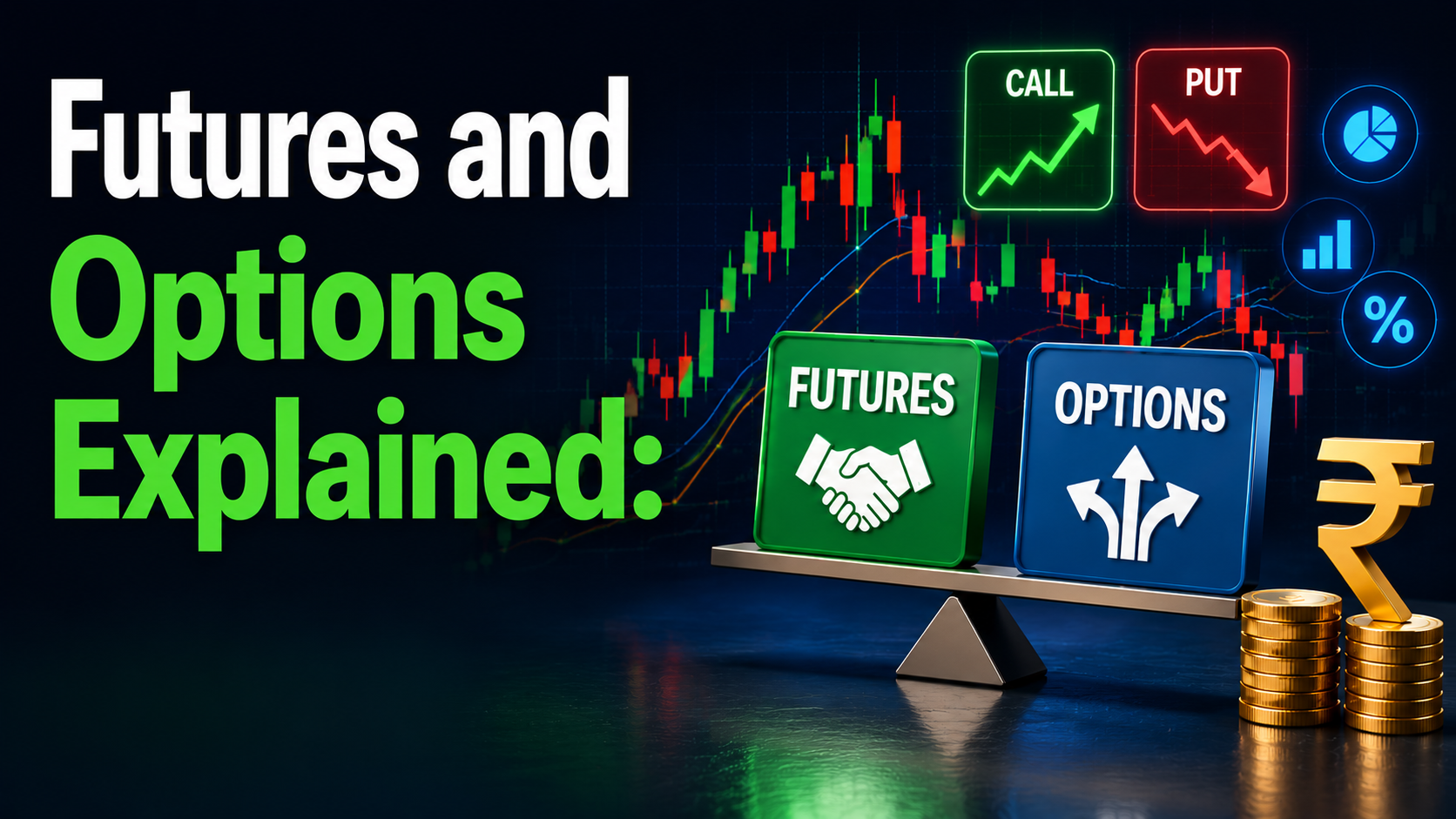
Introduction
If you've spent any time around stock markets or financial news, you've likely heard the terms futures and options thrown around — often in the same breath. These are two of the most widely traded financial instruments in the world, yet they remain mysterious to many investors.
This guide breaks down what futures and options are, how they work, their key differences, and how everyday investors use them — in plain, simple language.
What Are Derivatives?
Before diving into futures and options, it's important to understand that both are derivatives.
A derivative is a contract whose value is derived from an underlying asset — such as a stock, commodity (like gold or oil), currency, or index (like Nifty 50 or Sensex). When trading derivatives, you don't own the physical underlying asset itself; instead, you hold a legal contract that tracks its real-time price movements.
Think of it this way: It is like buying a token that tracks the price of a cricket match's outcome without actually owning the stadium, the players, or playing in the match yourself. Your profit or loss depends entirely on how the actual score performs relative to your token's position.
What Are Futures? (The Obligation Contract)
FFutures Contracts — A Binding Agreement
A futures contract is a legally binding agreement between a buyer and a seller to buy or sell an underlying asset at a predetermined price on a specific future date.
The Core Rule: In a futures contract, both parties face a strict obligation. The buyer must buy, and the seller must sell, no matter how high or low the market price moves by the time the contract expires.
How it works: If you buy a Nifty 50 futures contract at ₹24,000 expecting it to rise, and it climbs to ₹24,500 by expiry, you make a clean profit of ₹500 per unit. However, if it falls to ₹23,500, you are legally bound to fulfill the contract at the higher price, absorbing a ₹500 loss.
The Margin Catch: You don't pay the full value of the contract upfront. Instead, you deposit an initial fraction called a margin. While this magnifies your profits, it equally amplifies your losses if the market goes against you.
Best used for: Directional trading, directional hedging (protecting an existing portfolio), and high-volume institutional arbitrage.
Pro tip: Because futures involve daily cash settlement (Mark-to-Market), volatile swings require deep capital reserves. On platforms like ApexTrade, you can leverage up to 500X intraday margin on NSE Futures and MCX to maximize capital efficiency, provided you manage your stop-losses aggressively. Check current futures margin requirements →
Verdict: High predictability, clear tracking, but carries mandatory risk obligation.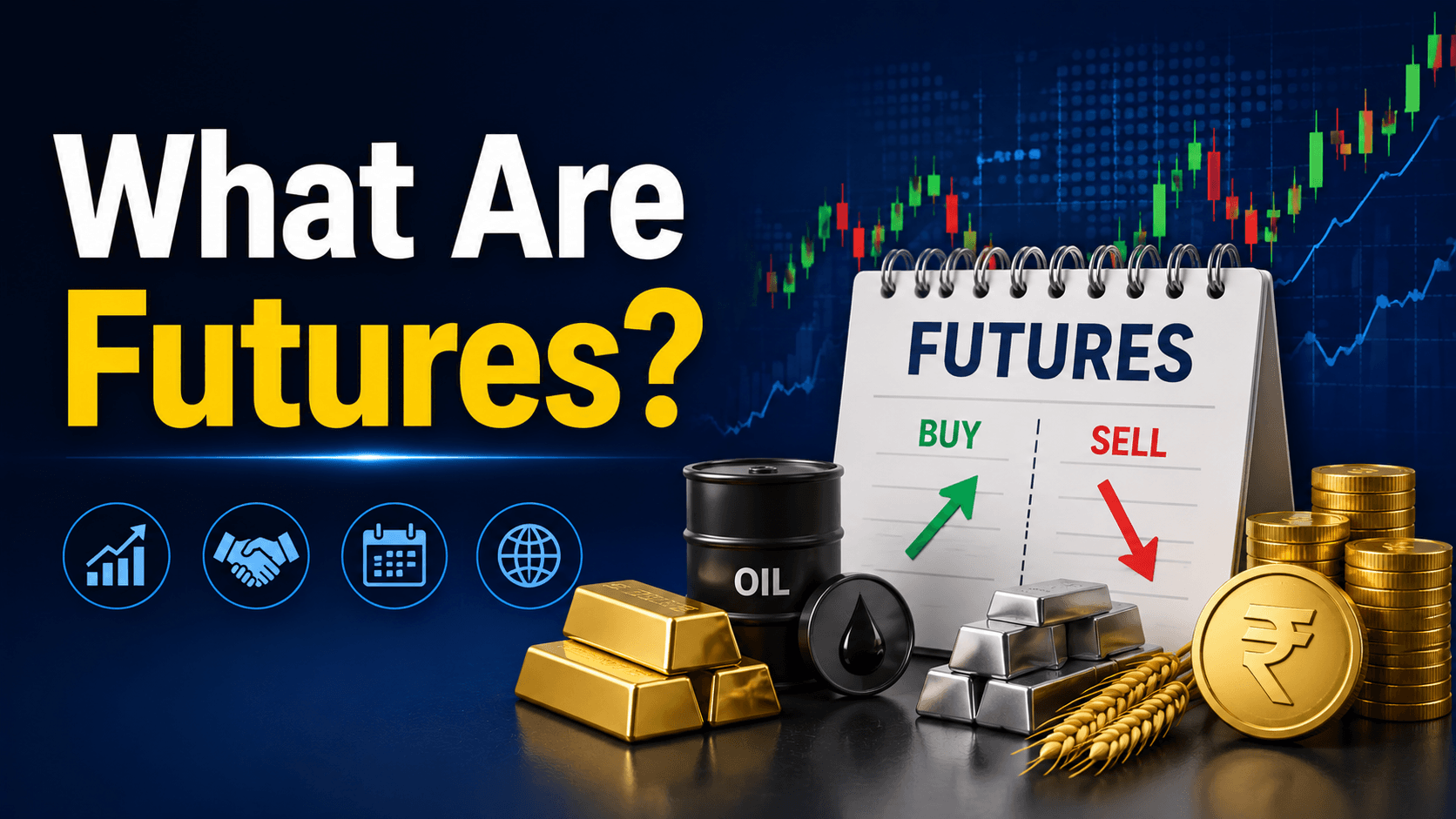
A futures contract is a legally binding agreement between two parties to buy or sell an asset at a predetermined price on a specific future date. Both parties are strictly obligated to fulfill the contract — the buyer must buy, and the seller must sell, regardless of what the actual market price is on that date.
A Real-World Example: Price Certainty
Imagine a wheat farmer who is worried that wheat prices might crash by harvest time. At the same time, a flour mill is worried that wheat prices might skyrocket, making production too expensive.
To lock in their costs, they enter into a futures contract: the farmer agrees to sell 1,000 kg of wheat at ₹25/kg three months from now. When the settlement date arrives, the market looks like this:
- If the market price drops to ₹20/kg: The farmer wins. He gets to sell his wheat at the higher agreed price of ₹25/kg, protecting his revenue. The mill pays more than the current market rate but had price certainty all along.
- If the market price jumps to ₹30/kg: The flour mill wins. They buy the wheat at the bargain price of ₹25/kg, saving on raw materials. The farmer sells below market rate but avoided the risk of a crash.
Key Features of Futures
Unlike options, both the buyer and the seller must complete the transaction at expiry. There is no backing out.
Contract sizes (lot sizes), expiry dates, and quality terms are rigidly fixed by the stock exchange (like NSE).
You only need to put up a small fraction (initial margin) of the total contract value to control a very large position.
Profits and losses are calculated and adjusted in your trading account automatically at the end of every single trading day.
👥 Who Participates in the Futures Market?
1. Hedgers: Core businesses looking to offset risk. Think of international airlines locking in fuel costs or manufacturing giants securing metal prices months in advance.
2. Speculators: Retail and institutional traders who have no interest in the actual asset but want to profit off sharp, short-term price directions.
3. Arbitrageurs: Quantitative investors who spot temporary price mismatches between different exchanges or the cash market and trade to lock in risk-free profits.
Whether you are looking to hedge an existing portfolio or speculate on intraday momentum, execution lag can break your strategy. ApexTrade utilizes sub-millisecond routing to ensure your futures orders hit the exchange matching engine instantly, minimizing slippage. Experience lightning-fast execution →
What Are Options? (The Choice Contract)
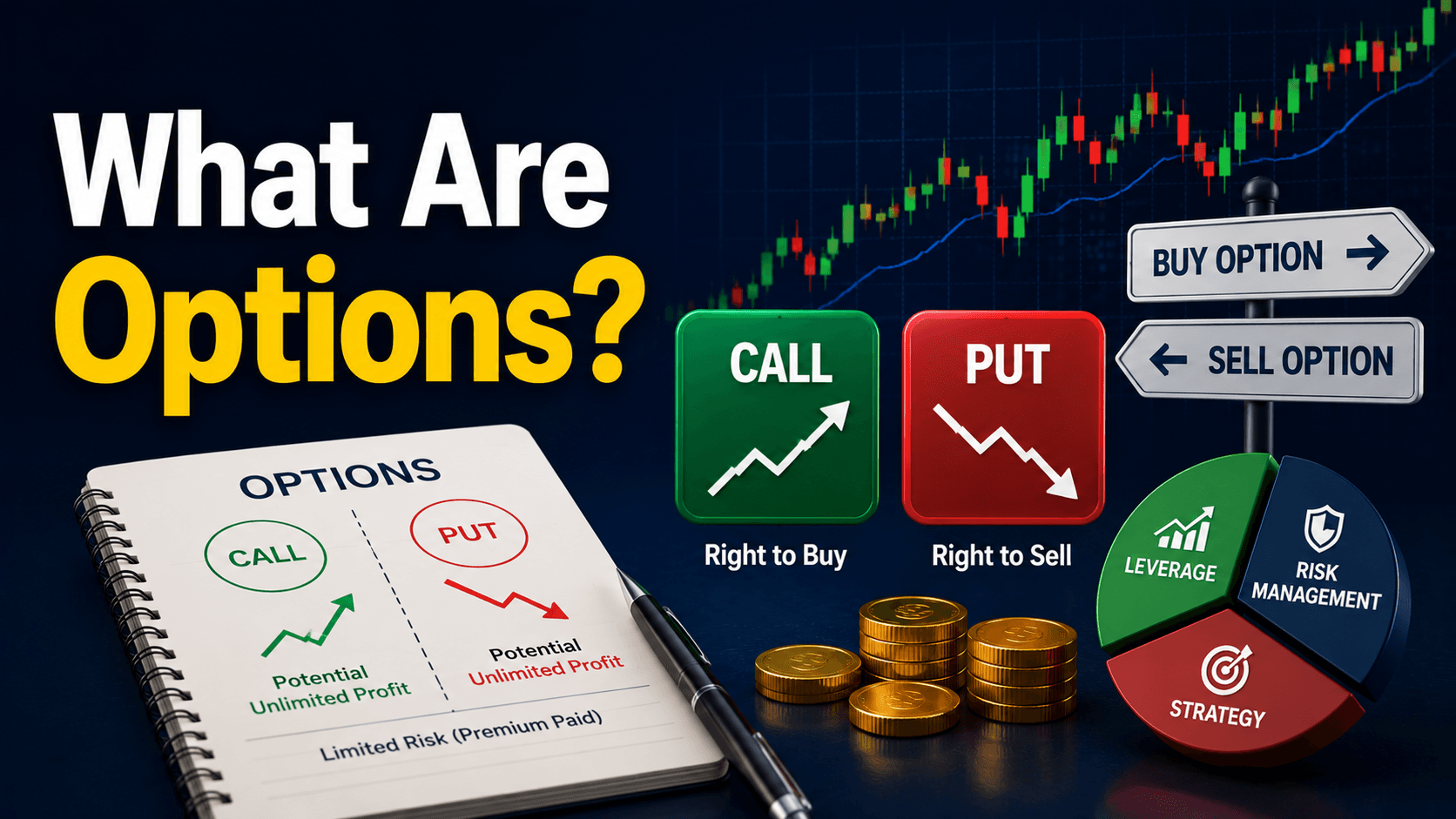
An options contract gives the buyer the right, but not the obligation, to buy or sell an asset at a predetermined price (called the strike price) before or on a specific date. Unlike futures, if a trade goes against an options buyer, they can simply choose to walk away. The only catch? They forfeit the non-refundable fee—called the premium—they paid upfront to secure that right.
The Two Tools: Calls and Puts
1. Call Option
Gives the buyer the right to buy an asset at the fixed strike price. You buy Call options when you expect the market prices to rise significantly.
2. Put Option
Gives the buyer the right to sell an asset at the fixed strike price. You buy Put options when you expect the market prices to drop sharply.
A Real-World Example: Trading Reliance
Suppose Reliance Industries shares are currently trading at ₹2,500, and you believe a major product launch will push the price up to ₹2,800 next month. Instead of spending ₹2,500 for a single share, you buy a 1-month Call Option with a strike price of ₹2,600 by paying an upfront premium of ₹50 per share.
When your contract reaches its expiry date, your outcome splits into two very different paths:
Your analysis hits the mark! You exercise your right to buy the shares at the locked-in strike price of ₹2,600. Since the open market is trading at ₹2,800, you score a gross gain of ₹200 per share. After accounting for your initial upfront premium of ₹50, your net profit is ₹150 per share.
The launch fails, and the price drops. Instead of being forced to buy over market value (like a futures contract would require), you simply let the option expire worthless and walk away. You completely avoid the heavy stock crash and only lose the ₹50 premium you paid at the start.
Key Features of Options
- Right, Not Obligation: The buyer holds complete control over whether to execute the contract or let it pass.
- The Premium Factor: The non-refundable financial fee paid directly from the buyer to the seller (writer) to activate the contract.
- Asymmetric Risk: Options buyers enjoy mathematically uncapped profit potential while keeping their total risk strictly limited to the premium paid.
Futures vs. Options: Key Differences at a Glance
| Feature | Futures | Options |
|---|---|---|
| Obligation | Mandatory settlement for both parties | Buyer chooses; seller must comply if exercised |
| Upfront Cost | Refundable Margin deposit (typically 15-25%) | Non-refundable Premium paid by buyer to seller |
| Risk for Buyer | Unlimited loss if the trade goes against you | Strictly capped at the premium paid upfront |
| Risk for Seller | Unlimited loss if the trade goes against you | Unlimited risk if selling (writing) naked contracts |
| Primary Use Case | Hedging commodities, linear direction trading | Strategic hedging, passive income, and leverage |
Common Terms You Should Know
Long vs. Short Position
Going Long means you have bought a contract expecting the price to increase. Going Short means you have sold a contract, planning to buy it back cheaper when prices drop.
Moneyness: ITM, ATM, and OTM
In the Money (ITM) options possess intrinsic profit value if exercised right now. At the Money (ATM) options have a strike price equal to the underlying stock value. Out of the Money (OTM) options contain no current execution value and consist purely of speculative time price.
Open Interest (OI)
The metric showing the total number of active, outstanding derivative contracts that have not yet been settled, closed, or exercised by traders.
Pro Execution Tip: Options pricing decay relies heavily on Greeks like Theta and Delta, which change fast during trading hours. Having an advanced order dashboard allows you to capitalize on dynamic pricing variations instantly. ApexTrade provides full Options Chain analytics along with sub-millisecond execution speeds, so you fill your derivatives positions right at peak liquidity. Explore the ApexTrade Options terminal →
How Are Futures and Options Traded in India?
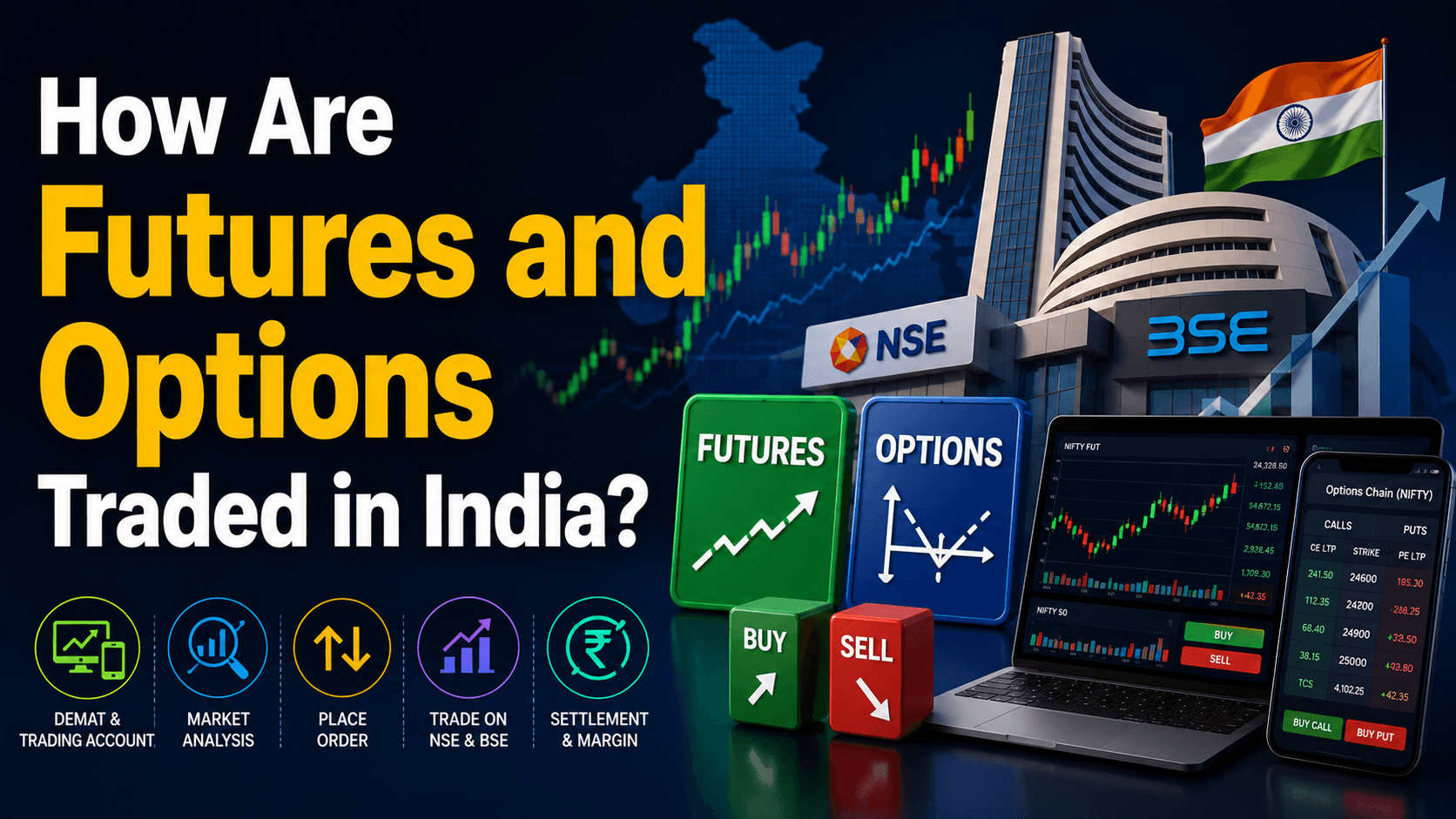
In India, the F&O (Futures & Options) segment is highly regulated and incredibly active. These derivative contracts are primarily traded across the nation's premier stock exchanges:
- NSE (National Stock Exchange): Dominates the derivatives market and consistently ranks as one of the largest F&O markets in the world by trading volume.
- BSE (Bombay Stock Exchange): Offers competitive liquidity, particularly through its benchmark index derivatives.
Traders in India can choose from a wide variety of approved underlying instruments:
Contracts tracking major indices like the Nifty 50, Bank Nifty, and Sensex.
Individual large-cap stocks specifically approved for derivatives trading by SEBI.
Contracts tracking global currency pairs such as the USD/INR, EUR/INR, and GBP/INR.
Contracts on Gold, Silver, and Crude Oil, traded primarily on the MCX (Multi Commodity Exchange).
The Expiry Cycle: In India, standard monthly contracts expire on the last Thursday of every month. If that Thursday happens to be a trading holiday, the contract expires on the preceding Wednesday. Major indices also offer highly liquid weekly options contracts for shorter-term strategies.
The Realities of Risk in F&O Trading
While the derivatives market offers massive profit potential, it is an inherently zero-sum game that involves significant financial risk. A few critical risk factors include:
⚠️ Double-Edged Leverage
Leverage amplifies losses just as dramatically as gains. A small price move against your position can completely wipe out your initial margin deposit within minutes.
⏳ Time Decay (Theta)
For options buyers, time is an enemy. The value of an options contract constantly erodes every day it approaches expiry, meaning you lose money if the underlying asset stays flat.
📉 Liquidity and Volatility
Sudden market developments can cause massive price gaps. If you are trading far-out-of-the-money or illiquid contracts, you may find it difficult or impossible to exit your trade at a fair price.
Important Safety Warning: Due to their complexity, futures and options are best suited for experienced investors with disciplined risk management rules. Beginners should focus on thorough study and practice via paper-trading simulators before risking real capital.
Choosing the Right Platform to Trade F&O
Understanding how contracts work is only half the equation — where you execute your trades matters just as much. Sub-optimal execution speeds, high brokerage overheads, and poor margin efficiencies can chip away at your profitability over time.
ApexTrade is built explicitly to solve these problems for modern derivatives traders. Serving as a commission-free online trading platform, it brings NSE Futures, MCX, and F&O trading under a single unified dashboard.
Why Active F&O Traders Use ApexTrade:
- ✓High Capital Efficiency: Access up to 500X intraday margin on NSE & MCX Futures alongside 7X leverage on Options to scale your strategies effectively.
- ✓Sub-Millisecond Speed: Enter and exit volatile setups instantly with specialized low-latency order routing engines.
- ✓Rapid Withdrawals: Process and settle your trading profits in under 30 minutes, any day, at any time.
- ✓Real Support: Skip the generic chatbots. Access 24/7 dedicated human support to resolve trading queries immediately when live market issues arise.
Ready to take control of your trading execution? You can open a fully operational digital Demat account completely free of charge in under 5 minutes. Open your free ApexTrade account today →
Who Should Trade Futures and Options?
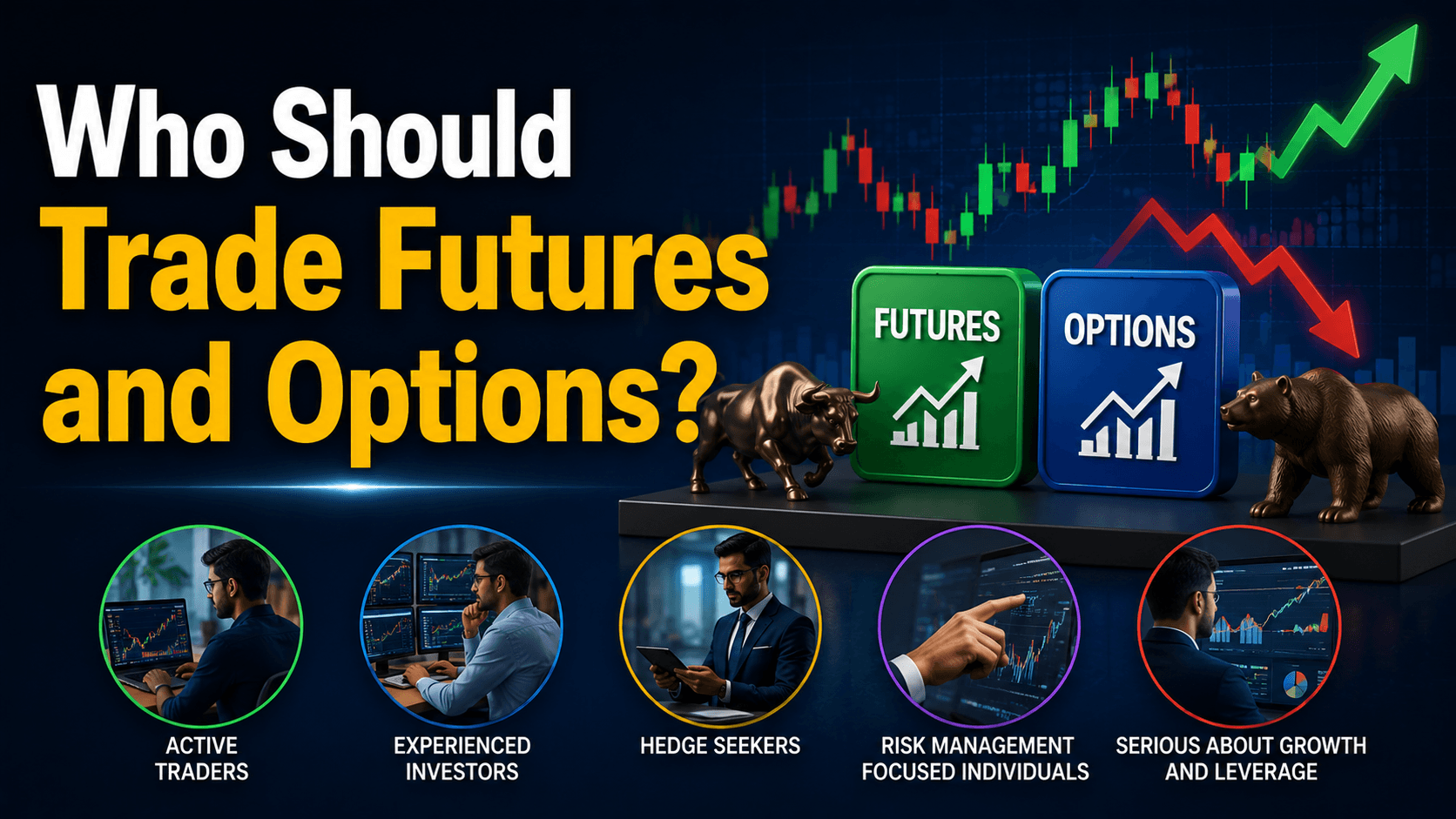
Because derivatives require active management and quick decision-making, they are not designed for every type of market participant. Understanding where you fit can save you from costly mistakes.
👍 F&O Trading is Suitable For:
- •Risk Hedges: Long-term stock investors looking to protect their equity portfolios from expected downside trends.
- •Experienced Traders: Market veterans who possess a strong psychological tolerance for leverage and sudden volatility swings.
- •Active Managers: Individuals who have dedicated time throughout the live market session to monitor adjustments closely.
- •Tax-Aware Investors: Those who understand Indian tax laws, where gross F&O earnings are classified and processed as business income rather than capital gains.
👎 It May Not Be Ideal For:
- •Complete Beginners: Individuals who lack foundational experience in cash equity or delivery markets.
- •Essential Capital Users: Anyone allocating savings, emergency emergency pools, or money they cannot comfortably afford to lose.
- •Passive Investors: People whose schedules or careers prevent them from managing or reacting to sudden intraday pricing moves.
Conclusion
Futures and options are incredibly versatile tools that underpin the mechanics of global finance. While futures contracts allow market players to lock in certainty by establishing flat obligations, options contracts give buyers tactical breathing room with defined, limited downside.
When approached with careful preparation and strict risk management, derivatives allow you to navigate both bull and bear cycles effectively. If you are prepared to transition your analysis into live market execution, deploying a platform optimized for low latency is paramount. Set up your commission-free workspace with ApexTrade and experience advanced, high-performance execution.
Have questions about F&O trading mechanics?
Whether you are trying to understand margin systems or analyzing options moneyness, drop your thoughts in the comment section below. Share this breakdown with a fellow trader!
Open Free Demat Account →