Hero Background
A Complete Guide to Trading Global Market Indices

Index Trading India

Whether you're looking to trade Indian benchmark indices or gain exposure to global markets, understanding how index trading works can help you identify opportunities across different economic sectors and market conditions.

Scroll
Value Proposition

Trade Global Indexes with Ease

Trade major global indexes with smooth execution, real-time market tracking, and diversified exposure to leading economies and industries.

Low Brokerage
Fastest Payout
24/7 Support
60X Holding
Access to Global Market Indexes
Competitive Index Trading Spreads
Fast & Stable Trade Execution
Real-Time Market Tracking
Secure & Transparent Trading
Dedicated Trading Assistance
Community

Join the ApexTrade community to avail the benefits!

Improving people's financial lives through strategic planning, high-frequency trading, and automated earning systems.

Global Access
24/7 Support
150K+ Members
Market Intelligence

What is Index Trading?

Index trading involves buying or selling financial instruments based on the structural performance of a stock market index. Instead of managing complex capital exposures in single isolated corporate entities, traders speculate on, or hedge against, the systemic trajectory of the broader market macro environments.

Strategic Edge

Why Elite Traders Select Indices

Instant Broad Diversification

Capture weighted exposures across massive foundational baskets of leading equity constituents through a singular transaction pipeline.

Mitigated Idiosyncratic Risk

Insulate active capital books against corporate gaps, earnings structural misses, and erratic single-stock management shifts.

Deep Institutional Liquidity

Execute high-volume orders seamlessly with razor-thin bid-ask spreads, driven by continuous market participant volume.

Global Macro Execution

Deploy cross-border geographical sector strategies across major international hubs without direct foreign physical equity custody.

Symmetric Directional Flexibility

Capitalize efficiently on comprehensive market expansions or macroeconomic regime contractions utilizing advanced short-side derivatives.

Global Frameworks

Benchmark Indices

An overview of the dominant liquid benchmarks across key domestic and international derivative clearing blocks.

Domestic Indian Matrices

Nifty 50

Tracks 50 of the largest, highly liquid blue-chip enterprises cleared on the National Stock Exchange (NSE).

Sensex

The foundational 30-stock market-cap-weighted index capturing the absolute core of the Bombay Stock Exchange (BSE).

Bank Nifty

A highly hyper-liquid, high-beta sector matrix tracking the capitalization of dominant domestic banking institutions.

International Liquidity Hubs

S&P 500

The definitive proxy for systemic large-cap US equity health, tracking 500 dominant enterprise weights.

Nasdaq 100

A high-beta, tech-heavy index encompassing the absolute vanguard of global innovation and growth sectors.

Dow Jones Industrial Average

One of the oldest price-weighted legacy architectural benchmarks tracking 30 blue-chip industry leaders.

FTSE 100 & DAX 40

Primary Western European capital metrics monitoring the top blue-chip tier of the London and Frankfurt exchanges.

Valuation Dynamics

Catalysts Influencing Index Pricing Mechanics

Because an index aggregates a structured portfolio of corporate entities, its intraday valuation changes respond directly to macro-economic data prints and systemic policy shifts.

Macro Data Metrics

  • Real GDP growth trajectories
  • Core & Headline Inflation logs
  • Manufacturing PMI prints

Monetary Interventions

  • Central Bank interest rate pivots
  • Systemic liquidity injections
  • Yield curve adjustments

Corporate Metrics

  • Aggregate earnings revisions
  • Heavyweight forward guidance
  • Sector capitalization balance

Systemic Sentiment

  • Geopolitical regime alterations
  • Cross-asset risk-on/risk-off cycles
  • Institutional capital re-allocations
Institutional TakeawayIndices serve effectively as both the comprehensive barometer of total economic health and a high-efficiency execution target. Mastery of index price structures allows modern market participants to extract alpha from macro movements while running strict, mathematical risk architecture parameters.
Execution Comparison Matrix

Index Trading vs Stock Trading

Analyze the distinct structural mechanics separating comprehensive system benchmarks from standalone, idiosyncratic corporate equity instruments.

Structural FeatureIndex TradingStock Trading
Market Exposure ScopeAggregated multi-company basket providing macro industrial footprint.Isolated single-entity exposure tethered to specific balance sheets.
Inherent DiversificationStructurally higher; systematic smoothing via composite asset allocation.Symmetrically lower; exposed entirely to centralized asset performance.
Idiosyncratic / Company RiskSubstantially reduced via index balancing algorithms and math structures.Pronounced; fully vulnerable to micro corporate operational failures.
Market Representation VectorCaptures comprehensive macroeconomic trends and broad-market health.Reflects independent business execution, products, and direct sector niches.
Core Volatility DriversDriven heavily by macro data prints, central policies, and thematic flows.Dictated by specific earnings statements, localized news, and corporate leadership.

*While both methodologies afford alpha generation vectors, index tracking is increasingly chosen by asset allocators seeking macro system efficiency.

Operational Onboarding

How to Start Index Trading

Unlock instant systemic cross-asset exposure by executing our clean, verified electronic account activation steps.

Step 01

Establish Trading Infrastructure

Open an authorized terminal portal engineered for ultra-low latency derivative and index feed calculations.

Step 02

Execute Vault Verification

Finalize regulatory documentation protocols to complete necessary identification screening matrixes.

Step 03

Provision Capital Allocations

Fund your account pipeline with liquid working cash balances designated for active margin buffers.

Step 04

Target the Benchmark Vector

Isolate your optimal index environment from a curated menu of global and domestic composite indexes.

Step 05

Analyze Systemic Catalysts

Evaluate macro policy directions, sector charts, and technical indicators before positioning risk.

Step 06

Deploy & Monitor Risk Parameters

Route your execution orders into active pools while applying meticulous risk-control stop architecture.

Institutional Pipeline

Why Trade Global Indices with Apex Trade?

Apex Trade deploys standard-setting architectural pipelines that provide instant, friction-free exposure to the most liquid market indexes globally.

Global Benchmark Vault

Access premium indices across multiple cross-border jurisdictions and sectors from one unified workspace.

Real-Time Telemetry Trackers

Engineered with institutional-grade data endpoints feeding microscopic chart movements without decay.

Optimized Execution Spread

Benefit from highly streamlined, hyper-competitive conditions configured to protect trading margin models.

Low-Latency Match Core

Reliable execution infrastructure built to prevent transaction drift even during high-velocity macro releases.

Hardened Security Perimeter

Rigorously maintained structural integrity modules shielding system assets and privacy variables.

Elite Command Support Desk

Direct line of contact to specialist operators offering prompt structural assistance around the clock.

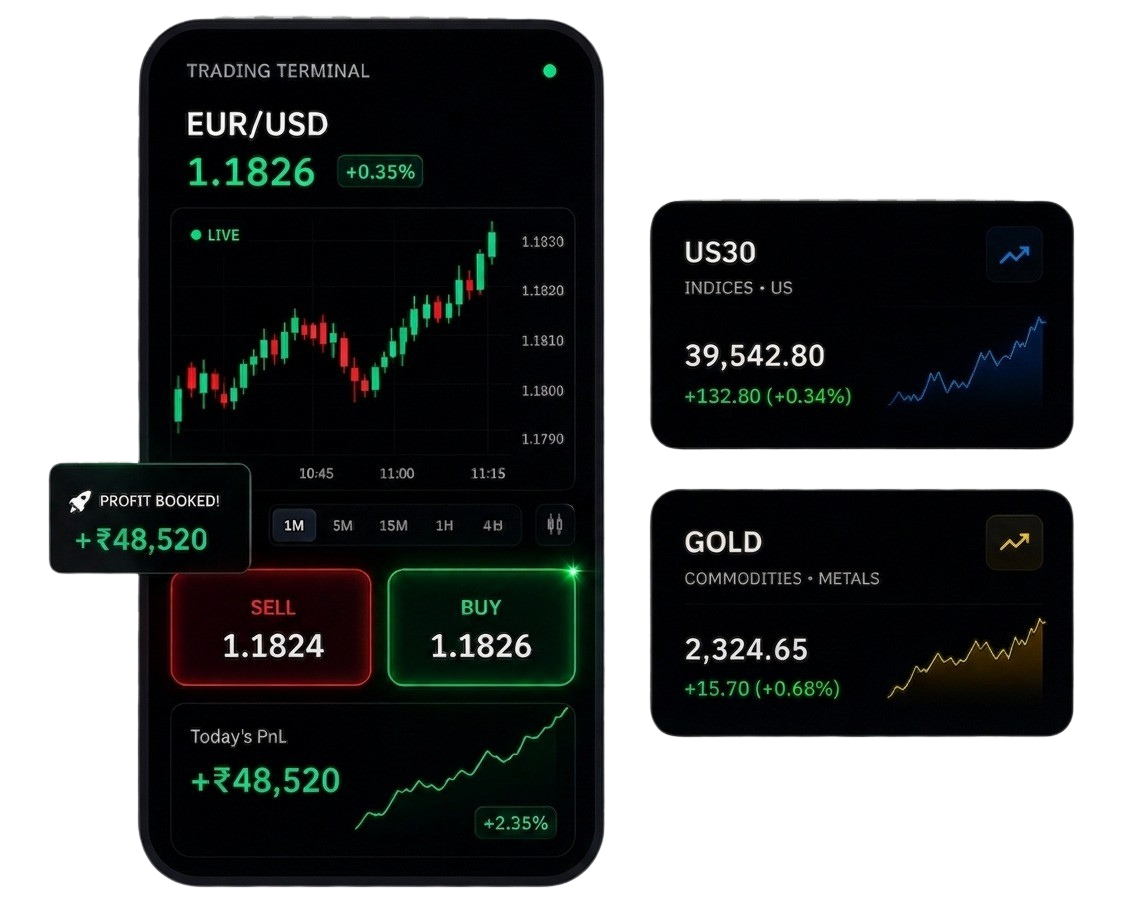
Whether deploying targeted local strategies across Indian benchmark indices or leveraging global liquidity events, Apex Trade serves as your comprehensive technological nexus for modern macro market exploration.
SUPPORT CENTER

Frequently Asked Questions

Frequently Asked Questions

Index trading involves speculating on the price movement of a stock market index rather than trading individual company shares.

Many beginners choose index trading because indices provide exposure to multiple companies and broader market trends.

Nifty 50, Sensex, and Bank Nifty are among the most actively followed and traded indices.

Yes. Modern trading platforms provide access to several global benchmark indices, including the S&P 500, Nasdaq, and Dow Jones.

Index trading offers diversification, liquidity, market-wide exposure, and opportunities across various economic conditions.