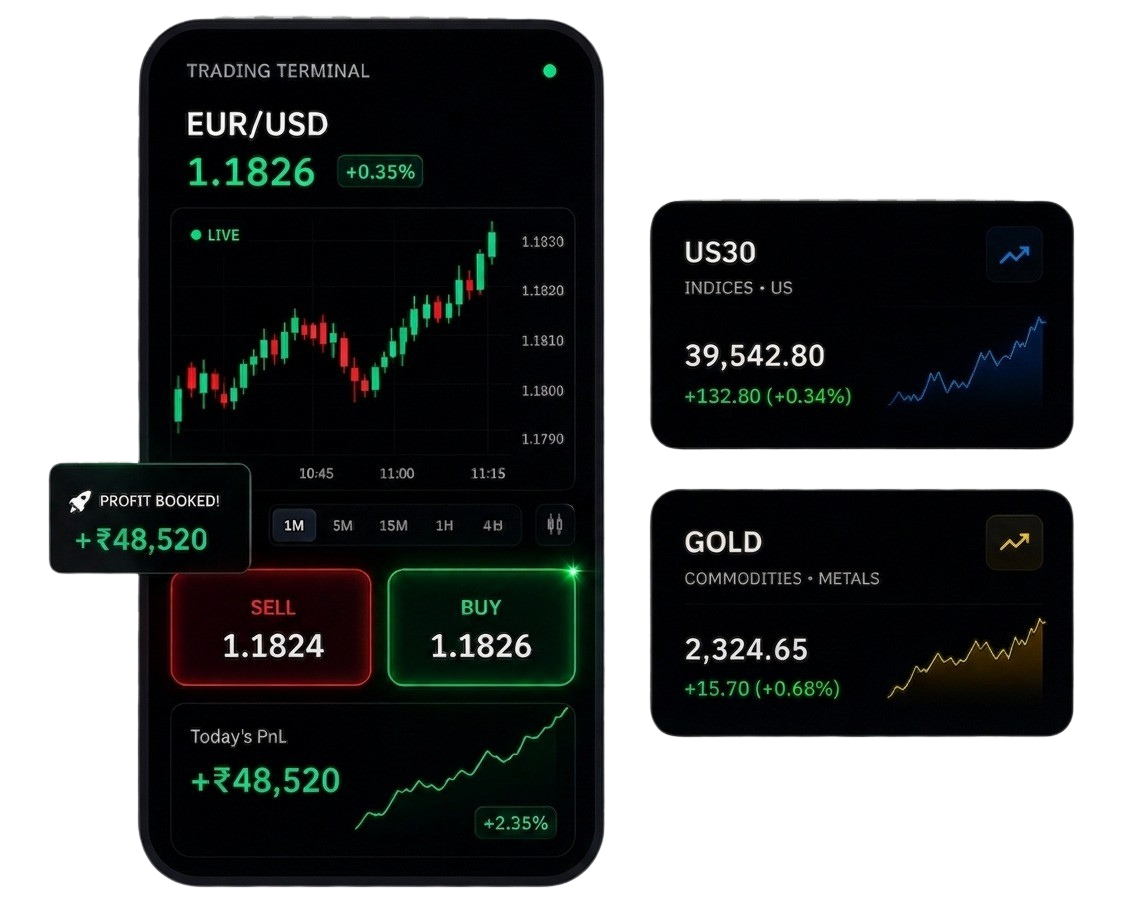
Access opportunities across leading exchanges including NSE, BSE, NASDAQ, and NYSE, through a powerful trading platform designed for modern investors and active traders. Whether you're looking to buy Indian stocks, explore global equities, or diversify your portfolio, Apex Trade provides the tools you need to trade smarter.

Access powerful equity trading tools with real-time market data, fast execution, and advanced analytics designed to help you make smarter investment decisions.
Improving people's financial lives through strategic planning,
high-frequency trading, and automated earning systems.
Learn the fundamentals of stock trading in India, understand market terminology, trading strategies, stock exchanges, risk management tools, and how to build a successful investing journey.
Stock trading is the buying and selling of shares in publicly listed companies to benefit from changes in market prices. When you buy a stock, you own a small stake in that company and participate in its potential growth over time.
These terms are often used interchangeably. A stock refers to ownership in a company, a share is a single unit of that ownership, and equity broadly refers to the ownership interest a shareholder holds in a company.
Traders can participate in markets in several ways, including intraday trading (buying and selling within the same day), swing trading (holding positions for days or weeks), positional trading (holding for weeks or months), and long-term investing (holding investments over extended periods).
The market offers various categories of stocks. Blue chip and large-cap stocks belong to well-established companies, while mid-cap and small-cap stocks may offer higher growth potential with varying levels of risk. Investors can also choose growth stocks, value stocks, and dividend-paying stocks depending on their objectives.
Stock prices are influenced by company earnings, financial performance, industry trends, economic conditions, interest rates, inflation, investor sentiment, and global geopolitical developments.
A Demat account holds your securities electronically in digital form. It is required for buying and selling shares on Indian stock exchanges and enables secure, paperless transactions.
The National Stock Exchange (NSE) and the Bombay Stock Exchange (BSE) are India's two primary stock exchanges. Both provide access to listed companies, and most major stocks are available on both exchanges.
A stop-loss order is a risk management tool that automatically exits a position when a stock reaches a predefined price level. It helps traders and investors limit potential losses and manage risk more effectively.
A dividend is a portion of a company's profits distributed to shareholders, typically on a quarterly or annual basis. Dividend payments depend on the company's profitability and dividend policy.
Yes. Platforms like Apex Trade provide access to major Indian exchanges such as NSE and BSE, along with international markets like NASDAQ and NYSE, allowing investors to manage domestic and global portfolios from a single account.
Investors commonly use fundamental analysis and technical analysis. Fundamental analysis evaluates a company's financial health through metrics such as earnings growth, P/E ratio, and return on equity, while technical analysis uses charts and indicators such as RSI, MACD, moving averages, and support and resistance levels to identify trading opportunities.
Yes, when conducted through a regulated and secure platform. It is important to choose a platform that offers strong security measures, transparent processes, reliable customer support, and compliance with applicable regulations.