
Amplify Your Market Opportunities with Apex Trade
Margin Trading India
Scroll
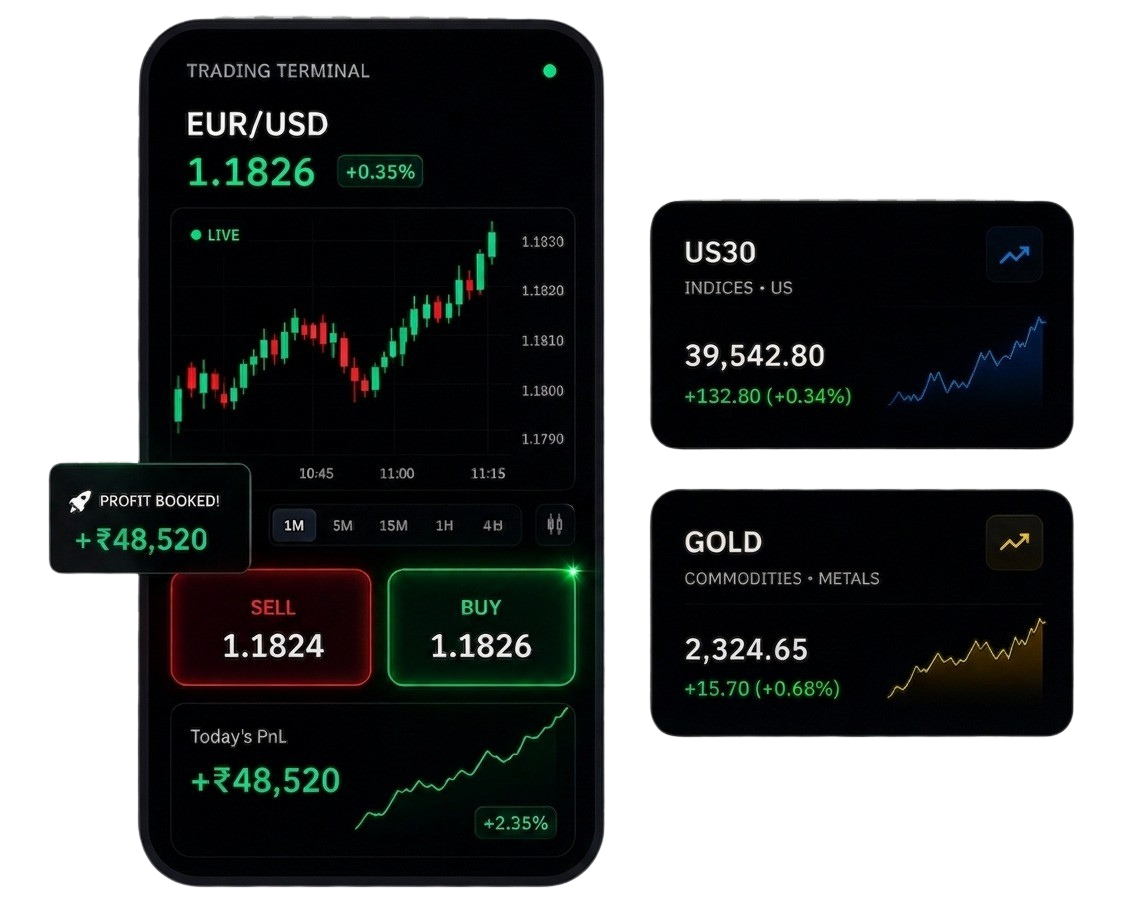
Enhance your buying power with flexible margin options, optimized leverage, and built-in risk controls for efficient capital utilization.
Improving people's financial lives through strategic planning,
high-frequency trading, and automated earning systems.
Real outcomes from real people - traders who made the switch and never looked back.
"Switching to this platform completely changed how I approach each session. The signals are consistent, the execution is fast, and my confidence in every trade has grown measurably."
Intraday Trader · NSE Futures
"I tested a handful of platforms before settling here. Nothing else came close on execution speed or support response time. Trading feels noticeably smoother every single day."
Options Trader · MCX
"The analytics depth here is genuinely rare. Real-time data, clean interface, no lag — it gives me clarity that helps me make better decisions under pressure."
Positional Trader · Equities
"The built-in risk controls saved me from a costly mistake early on. The platform manages exposure intelligently and the order fills are consistently at the price I expect."
Commodity Trader · MCX
"Managing a portfolio of this scale requires a platform you can trust completely. ApexTrade delivers on uptime, speed, and support every time — no exceptions."
HNI Trader · Multi-Segment
"I was brand new to active trading when I joined. The platform is intuitive, the knowledge resources are genuinely useful, and the support team walked me through everything I needed."
Beginner Trader · NSE Equities
Understand how margin trading works in India, its benefits, risks, leverage mechanics, and the risk management practices every trader should know before using margin facilities.
Margin trading is a facility that allows traders to take larger positions in the market by using funds borrowed from their broker. Rather than trading solely with your own capital, you gain additional buying power to participate in bigger market opportunities while keeping your own funds working efficiently.
A trader deposits funds into their trading account, and the broker extends additional buying power through a margin facility. The trader can then open positions larger than their deposited capital. Profits and losses are calculated on the full position size, and risk management tools help maintain account stability during market fluctuations.
Margin trading can be used across a range of asset classes including stocks, commodities, and indices, giving traders the flexibility to respond to opportunities across different markets and conditions.
The key benefits include enhanced buying power, more efficient use of capital, the ability to participate in short-term market movements, flexibility across multiple asset classes, and the potential for higher returns when leverage is used responsibly and with proper risk management.
Yes. Because profits and losses are calculated on the full position size rather than just your deposited capital, losses can exceed what they would be in regular trading. This is why disciplined risk management and a solid understanding of leverage are essential before using margin facilities.
Margin trading is generally most suitable for active intraday traders, short-term market participants, and experienced traders who understand leverage and have disciplined risk management practices in place. It is most effective when combined with proper market knowledge and a well-defined trading strategy.
Margin trading carries additional risk compared to regular trading because of the leverage involved. Beginners are advised to first build a strong understanding of how markets work, how leverage amplifies both gains and losses, and how to apply sound risk management before using margin facilities.
A well-designed margin trading platform includes advanced risk controls to help traders manage their exposure. These may include automatic position monitoring, margin call alerts, and mechanisms to maintain account stability during volatile market conditions.
In regular trading, you can only buy securities up to the value of the funds in your account. With margin trading, your broker extends additional buying power, allowing you to control larger positions. This amplifies both potential gains and potential losses compared to trading with your own capital alone.
Before using margin facilities, it is important to understand how leverage works, set clear risk limits, use stop-loss orders to manage downside exposure, avoid over-leveraging your account, and continuously monitor open positions. Margin trading works best as part of a disciplined, well-planned trading strategy.