
If you've spent any time on trading forums or scrolling through your broker's app, you've probably come across the term "MTF" or "margin trading facility" attached to certain stocks. It sounds technical, but the concept behind it is fairly simple: it's a way to buy more shares than your account balance would normally allow, by borrowing the rest from your broker.
At Apex Trade, we believe informed traders make better decisions. So let's break down exactly what a margin trading facility is, how it works, and — just as importantly — where it can go wrong if you're not careful. If you're new to the markets and want to understand the basics of trading first, click here.
What Is a Margin Trading Facility?

A margin trading facility (MTF) is a service offered by stockbrokers that lets you purchase shares by paying only a fraction of the total transaction value upfront, while the broker funds the rest. In exchange, the broker charges interest on the borrowed amount, and the shares you buy typically serve as collateral for the loan.
In simple terms: instead of paying 100% of a stock's price out of your own pocket, you might pay 20-50% (the "margin"), and your broker covers the remainder. This lets you control a larger position with a smaller amount of capital.
Margin trading facilities are regulated — in India, for example, SEBI (Securities and Exchange Board of India) has laid down specific rules brokers must follow when offering MTF, including which stocks are eligible, minimum margin requirements, and disclosure norms.
How Does Margin Trading Work?
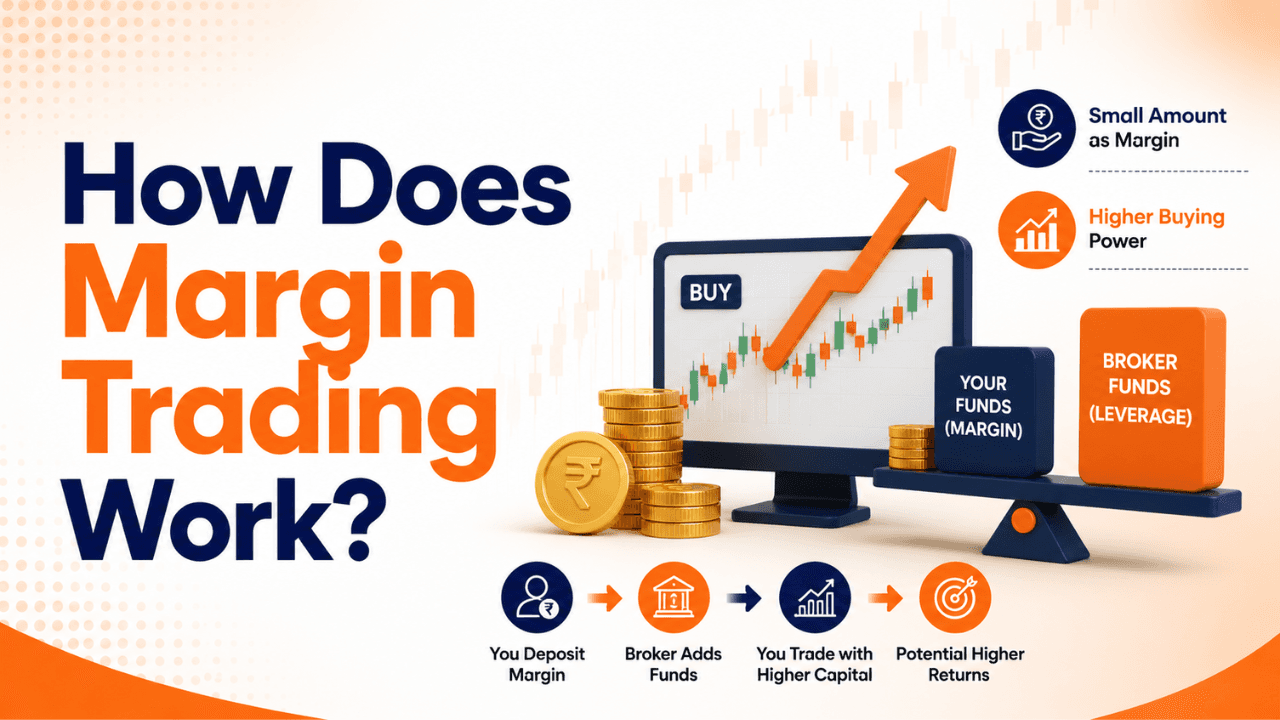
Here's a simplified walkthrough of how margin trading typically plays out:
- You open an MTF account. Most brokers require you to enable margin trading separately from a regular trading account, often with additional documentation.
- You select an eligible stock. Not every stock qualifies for MTF — brokers and exchanges maintain a list of approved securities based on liquidity, volatility, and other risk factors.
- You pay the margin. Say a stock costs ₹1,00,000 for the quantity you want, and your broker requires a 40% margin. You pay ₹40,000, and the broker funds the remaining ₹60,000.
- Interest accrues on the borrowed amount. The broker charges interest (usually daily) on the funded portion until you either sell the stock or pay off the outstanding amount.
- The stock acts as collateral. If the stock's value falls significantly, your broker may issue a margin call, asking you to add more funds or sell the position to cover the shortfall.
Margin Trading vs. Regular (Delivery) Trading
| Aspect | Regular/Delivery Trading | Margin Trading |
|---|---|---|
| Capital required | Full amount upfront | Partial amount (margin) |
| Ownership | Immediate, full ownership | Shares held as collateral until dues cleared |
| Cost | No interest | Interest charged on borrowed funds |
| Risk | Limited to capital invested | Amplified, due to leverage |
| Ideal for | Long-term investors | Short-to-medium term traders |
Why Do Traders Use a Margin Trading Facility?
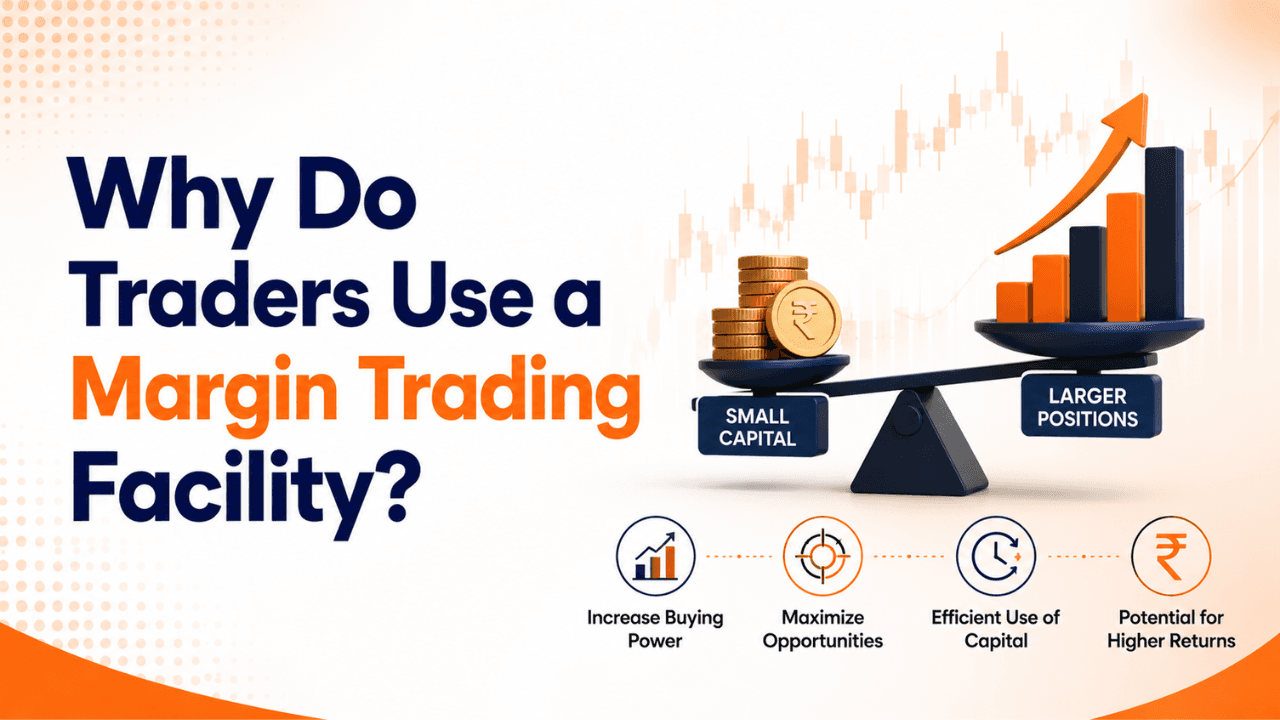
- Leverage to maximize potential returns The most obvious appeal of MTF is leverage. If a stock you've researched well moves in your favor, your returns are calculated on the full position size — not just the amount you personally put in. This can significantly amplify gains on a smaller capital base.
- Capital efficiency Instead of tying up your entire capital in one stock, margin trading lets you free up funds for other opportunities or as a buffer for volatility.
- Taking advantage of short-term opportunities Markets often present short windows of opportunity — a positive earnings surprise, a sector rally, or breaking news. MTF allows traders to act on these swiftly without needing the full capital ready at hand.
The Risks You Need to Understand
Leverage is a double-edged sword, and this is where many new traders get into trouble.
- Amplified losses: Just as gains are magnified, so are losses. If the stock moves against you, you could lose more relative to your own invested capital than you would with regular trading.
- Margin calls: If the stock price drops below a certain threshold, your broker will demand additional funds. Failure to meet a margin call can result in forced liquidation of your position — often at an unfavorable price.
- Interest costs eat into profits: The longer you hold a leveraged position, the more interest accumulates. If your stock doesn't move quickly enough in your favor, interest costs can erode or wipe out your gains.
- Emotional decision-making: Leverage tends to amplify emotions too. The pressure of a margin call or a fast-moving loss can lead to panic decisions.
Who Should Consider Using MTF?

Margin trading facilities are generally better suited to:
- Traders with prior market experience who understand risk management
- Those with a clear, researched thesis on a stock's short-to-medium term movement
- Traders who actively monitor their positions and can respond quickly to margin calls
- People who are financially prepared to absorb potential losses beyond their initial capital
It's generally not recommended for beginners, or for anyone using funds they can't afford to lose.
Practical Tips for Trading on Margin
- Never use your entire margin limit. Just because your broker allows you to leverage a certain amount doesn't mean you should max it out. Keep a buffer for market volatility.
- Set a strict stop-loss. With leverage, losses compound faster. A predefined stop-loss helps you exit before a small dip becomes a forced liquidation.
- Track interest costs. Factor in daily interest when calculating your breakeven point — a position that looks profitable on paper might not be once financing costs are included.
- Time your trades well. Since margin positions accrue interest and carry higher risk, entering and exiting at the right moments matters even more. If you're trading intraday on margin, understanding which time frame suits your strategy can make a real difference — check out our guide on the Best Time Frame for Intraday Trading (1-Min to 60-Min Explained).
- Avoid margin trading in highly volatile or illiquid stocks. Sudden price swings in low-liquidity stocks can trigger margin calls faster than you can react.
- Keep extra funds on standby. Having idle cash ready to meet a margin call can save you from being forced to sell at a loss.
- Review your positions daily. Margin positions require more active monitoring than delivery-based investments.
- Understand your broker's specific MTF terms. Interest rates, eligible stocks, and margin requirements vary between brokers — read the fine print before you start.
Final Thoughts
A margin trading facility can be a powerful tool for traders looking to make the most of short-term opportunities without tying up large amounts of capital. But that power comes with real risk — leverage doesn't just multiply your potential gains, it multiplies your potential losses too.
Before using MTF, it's worth asking yourself: do you have a solid trading plan, a clear risk management strategy, and the discipline to act on it — even under pressure? If the answer is yes, margin trading could be a useful addition to your trading toolkit. If you're still building that foundation, it may be worth gaining more experience with regular trading first.
Disclaimer: This article is for informational purposes only and does not constitute financial or investment advice. Trading and investing in securities markets are subject to market risks. Please consult a registered financial advisor before making investment decisions.